In the world of painting, some artists choose to depict the beauty of life through familiar images, while others want to go beyond imitating what the naked eye can see. They seek to express emotions, thoughts and the layers of meaning hidden deep within people and things. Dang Xuan Hoa is one of the artists who takes such an approach.
With works that combine human figures, familiar objects and an emotionally rich visual language, Dang Xuan Hoa has built a distinctive mark in contemporary Vietnamese art. His paintings do not necessarily follow conventional rules of arrangement. Forms are sometimes transformed, space seems spontaneous, and color is used as a vehicle for emotion rather than merely a description of reality.
Dang Xuan Hoa's artistic journey is also tied to a notable period in Vietnamese art, especially the post-Doi Moi era and the emergence of the Gang of Five group of painters. To better understand this artist, let us explore his early years, his education, his painting style and his contributions to Vietnamese painting.
Biography and Education
Dang Xuan Hoa is a Vietnamese painter from the generation of artists who matured during the country's period of transformation in art. He was born in 1959 in Nam Dinh and graduated from the Hanoi University of Fine Arts in 1983. Over the course of his career, he became one of the notable figures of contemporary art and a member of the Gang of Five, a group of artists who created new movements in Vietnam's painting scene in the early 1990s.
From a young age, Dang Xuan Hoa had a special love for painting. In an interview with the Van Nghe (Literature and Arts) newspaper in July 2024, he said that he had loved drawing since childhood. However, the path to a professional art career was not entirely easy. He took the entrance exam for the Hanoi University of Fine Arts three times before being admitted.
His studies from 1979 to 1983 gave him a foundation of knowledge in painting, from the basic principles of form to the ability to observe and practice composition. This rigorous education laid the groundwork for him to keep exploring and developing his own artistic language in the years that followed.
A notable point in Dang Xuan Hoa's view of creation is that he does not regard foundational knowledge as the final limit of the artist. In his view, knowledge gives a painter greater creative capacity, but being too dependent on ready-made molds can also narrow artistic freedom.
This is one of the thoughts that partly explains his approach to painting: respecting the traditional foundation while constantly seeking new ways of expression.
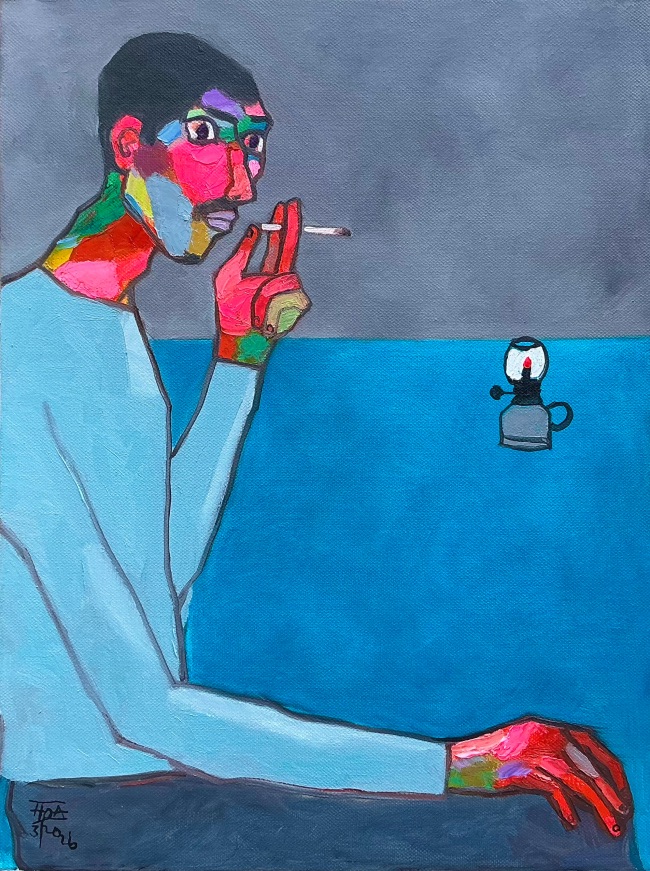
“Light” – Oil on canvas, 60cm x 80cm.
The Gang of Five
When speaking of Dang Xuan Hoa, one cannot overlook the Gang of Five, also known as "Bo Ngu". The group consists of five artists: Dang Xuan Hoa, Tran Luong, Ha Tri Hieu, Pham Quang Vinh and Hong Viet Dung.
The group formed and was active in the early 1990s, at a time when Vietnam was undergoing many economic, social and cultural changes following the Doi Moi reforms. The art scene was gradually opening up, allowing young artists to look for ways of expression that differed from the familiar approaches of the past.
What is notable about the Gang of Five is not that all five painters pursued the same style. Each had his own artistic personality, but they shared a spirit of experimentation, a desire to expand the limits of expression and a search for a personal voice in painting.
According to Dang Xuan Hoa, the group's first exhibition was held at 7 Hang Khay Street, Hanoi, in 1990, on the occasion of the 100th anniversary of the death of the great painter Vincent van Gogh. It was a memorable milestone for the young artists of that time, when solo and group exhibitions were not yet as common as they are today.
The exhibition was not only an occasion to present the work of the five painters but also gave other young artists more motivation to boldly express their creative individuality.
It can be said that the emergence of the Gang of Five reflects the exploratory spirit of a generation of artists during a period of transformation in Vietnamese art. For Dang Xuan Hoa, it was also an important time to gradually affirm his own direction and expand his artistic activities.

Painting Style
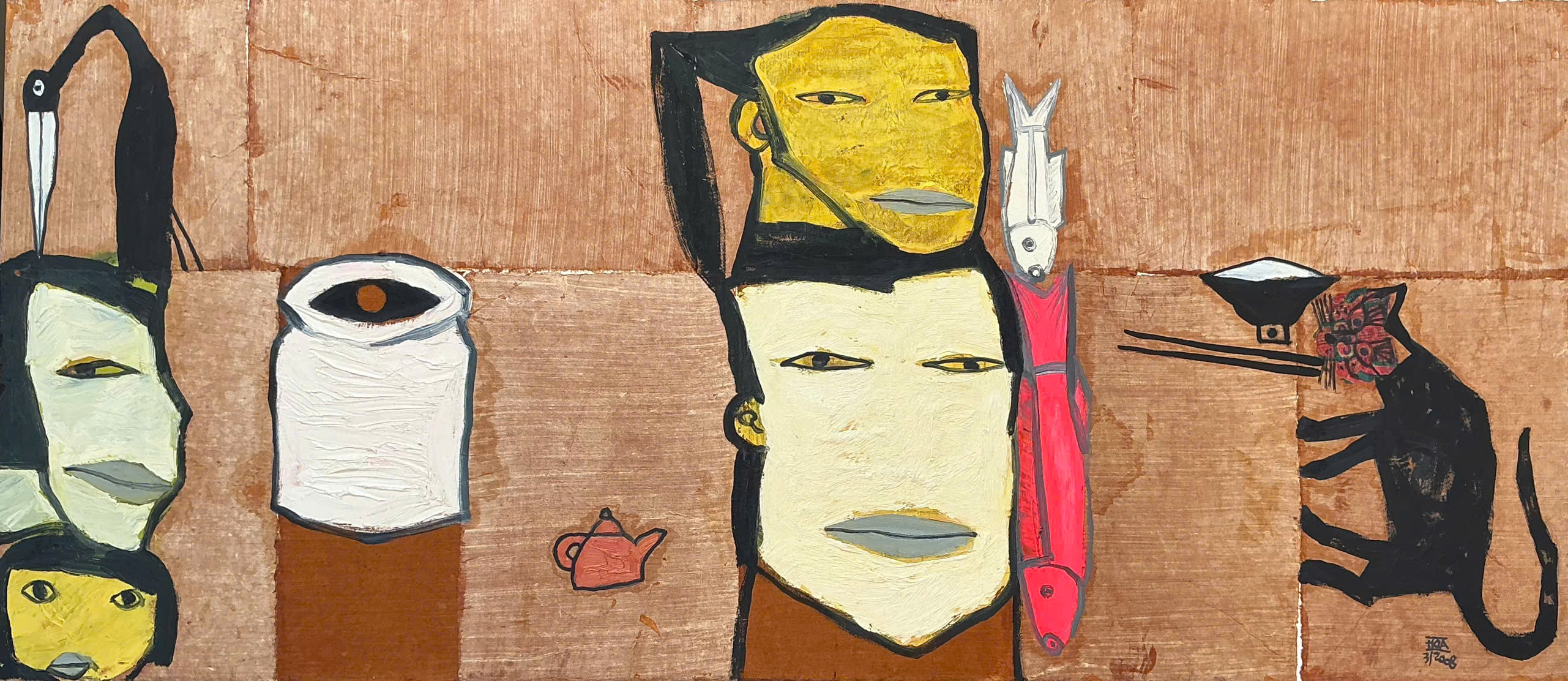
What draws attention to Dang Xuan Hoa's paintings lies not only in their subject matter but also in the way he organizes imagery, color and space on the canvas. Rather than trying to depict everything in true proportion and form as in real life, he often deliberately transforms forms to emphasize the emotion and personality of the work.
In many works, viewers may encounter faces shaped by strong areas of color, somewhat rough lines, and compositions that do not follow conventional arrangements. However, this spontaneity does not mean a lack of control. His use of color and organization of imagery still create a distinctive visual coherence.
A notable characteristic of Dang Xuan Hoa's paintings is the meeting of realist, expressive and abstract imagery.
Human figures, objects and familiar images remain clearly present in many works. However, these images are not necessarily reproduced intact. Sometimes faces are elongated, lines are simplified, or forms are transformed according to the artist's emotions.
This treatment lets the paintings go beyond mere description. Viewers can recognize a figure, a vase or a flower, while also sensing the state of mind the artist wants to convey.
This is what gives Dang Xuan Hoa's visual language its distinctiveness, as figurative and abstract elements can coexist in one creative space.
Color
Color plays an important role in his works. Rather than using color only to reproduce the exact colors of things, Dang Xuan Hoa often explores the expressive power of areas of color and contrast.
Some paintings use warm palettes that create a strong feeling, while others combine softer tones to highlight the central figure. Areas of color placed side by side create movement, sometimes giving the composition an irregular feel while still holding visual appeal.
According to The Factory Contemporary Arts Centre, his paintings have a refined and visually appealing palette, while the figures are often arranged spontaneously and may be deliberately transformed.
As a result, when looking at Dang Xuan Hoa's paintings, viewers notice not only the images depicted but can also sense how color and line create the work's own rhythm.
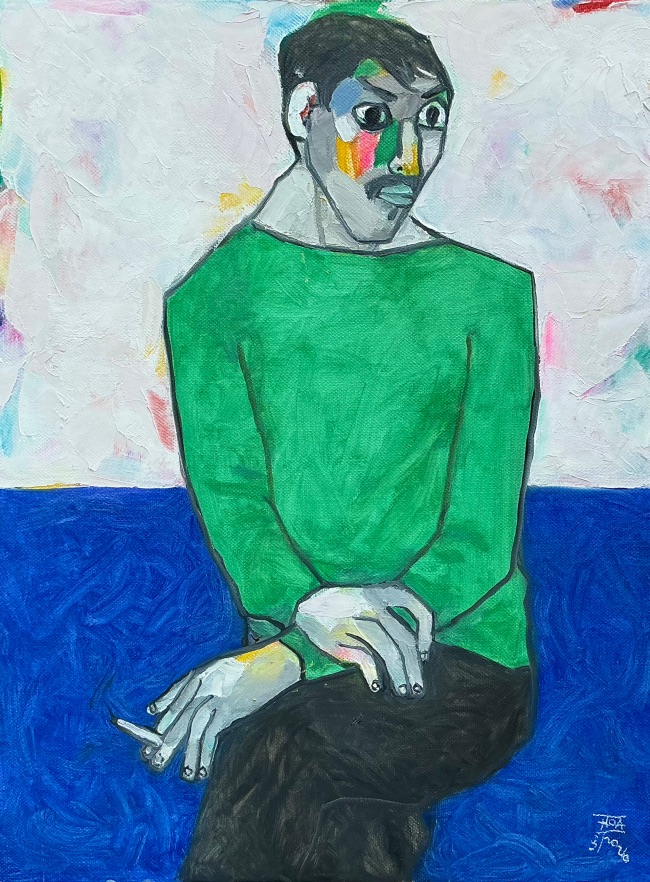
“Self Portrait” – Oil on canvas, 60cm x 80cm.
Familiar Objects and Motifs
One of the things that shapes the identity of Dang Xuan Hoa's painting is the presence of images familiar from Vietnamese life and culture.
Objects such as ceramic jars, flower vases, oil lamps, fruit bowls and images of cats often appear in his works. These are not unfamiliar subjects, but through the painter's treatment they are placed into new relationships with people and the space around them.
These humble objects can carry decorative value, evoke family memories or create a connection with traditional cultural elements.
In particular, familiar motifs and images not only serve as a backdrop for the figures but sometimes become an important part of the artistic story.
Portraits and Self-Portraits
Alongside still lifes, portraiture is one of the themes that runs through Dang Xuan Hoa's career. If still lifes allowed him to experiment with objects, color and composition, portraits opened a clearer space for expressing personal thoughts and emotions.
The figures in his paintings often have faces with strong lines, prominent eyes and areas of color treated in their own way. Some portraits have a pensive air, while others feel direct and forceful, as though the subject were looking straight at the viewer.
Notably, his self-portraits also reflect the artist's process of getting to know himself. According to The Lecht Collection, Dang Xuan Hoa spent many years creating portrait works and was influenced to a certain extent by Vincent van Gogh's way of expression.
However, that reference does not mean copying a style. He took on the expressive spirit and then transformed it into his own visual language, tied to the emotions and experience of a Vietnamese painter.
Through these portraits, people are seen not only by their outward appearance but also through psychological states, reflection and their connection to the space they live in.
Notable Works
To better understand Dang Xuan Hoa's painting style, looking at some of the works featured in art collections gives viewers a more concrete view of his development.
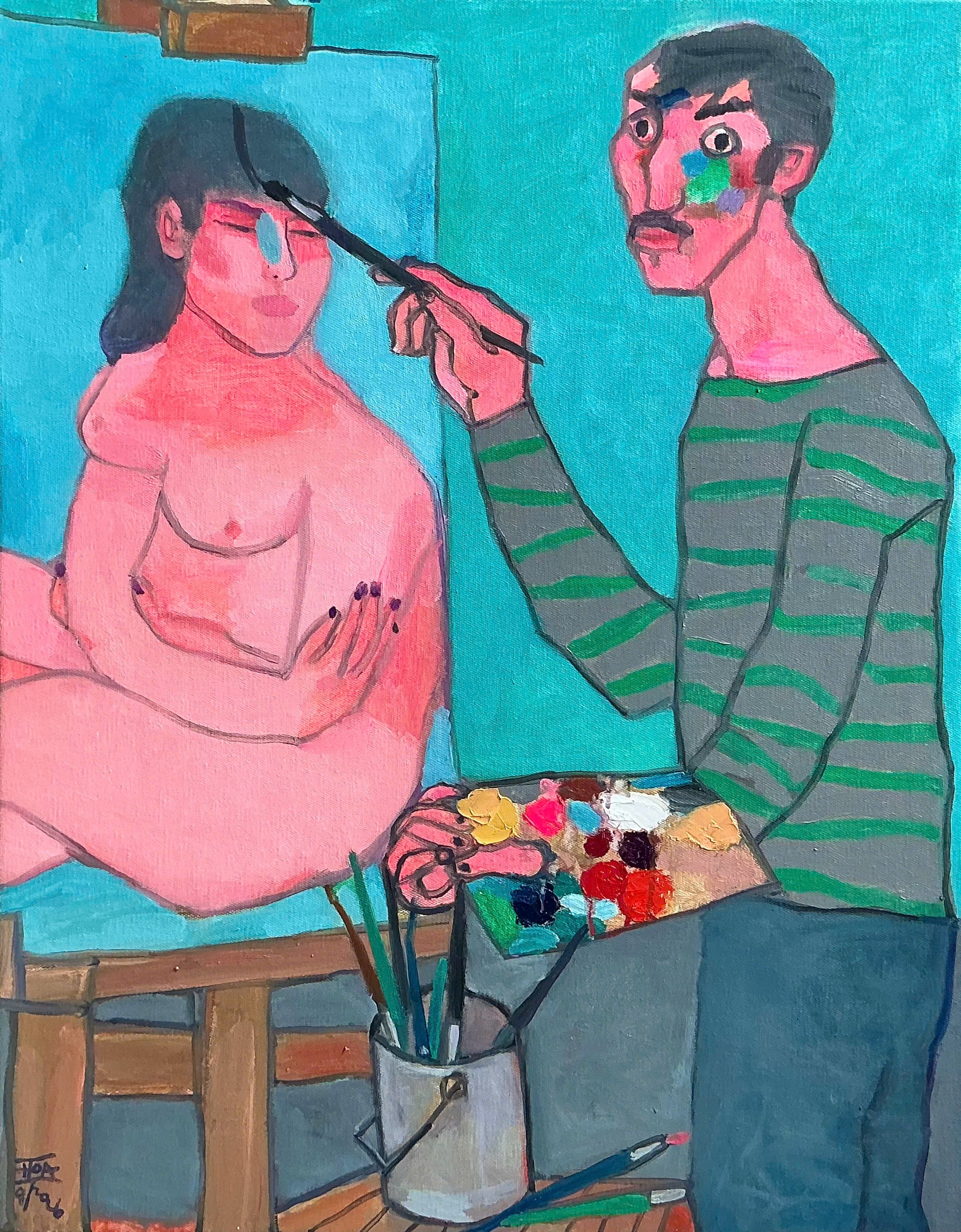
“The Nude Model 2026” – Oil on canvas, 70cm x 90cm.
View more paintings by Dang Xuan Hoa →


